Signals from the body.
Needling stimulates tissues and sensory nerves. Signals travel into spinal and brain pathways, where they may influence how the body processes sensation and pain.
ACUPUNCTURE / NERVOUS SYSTEM / HUMAN EXPERIENCE
Acupuncture brings precise needling and individualized clinical observation into the work with pain, physical tension, and your experience of stress.
In my practice, Chinese medicine and attention to physiology inform how acupuncture fits within your integrative 60-minute session.
Explore the connections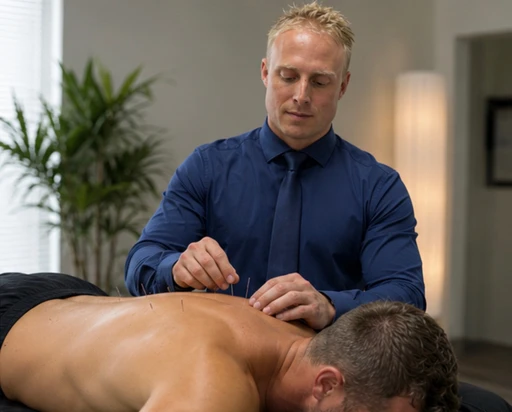
CHINESE MEDICINE & CLINICAL UNDERSTANDING
My approach draws on Chinese medicine as a framework for observing relationships and patterns, alongside a biomedical understanding of physiology. Traditional concepts and modern mechanisms are different ways of describing experience; they do not have a simple one-to-one translation.
Acupuncture uses very fine needles placed at selected sites. Your concerns, health history, presentation, and response inform the selection and the direction of care.
How this fits your session: We discuss your priorities and decide whether acupuncture is useful for the work that day. Physical symptoms and emotional experience can be explored together when relevant, without assuming one explains the other. Needling may be combined with movement or other care, and your feedback guides any adjustments.
The aim is thoughtful, responsive treatment. No single model captures everything about a person or explains every symptom.
FROM SENSATION TO RESPONSE
Needling stimulates tissues and sensory nerves. Signals travel into spinal and brain pathways, where they may influence how the body processes sensation and pain.
Research explores local tissue effects and the body’s own pain-modulating pathways. Acupuncture’s effects are not fully explained by one mechanism; the treatment context and expectations can also contribute.
The autonomic nervous system helps adjust functions such as heart rate and digestion. Researchers are investigating how acupuncture influences these responses. It is not simply a switch from “fight-or-flight” to “rest-and-digest.”
Mechanism research helps us ask better questions. It does not establish that every treatment produces the same physiological change.
Read the NCCIH evidence overview ↗REGULATION & INTEGRATION
In this practice, emotional regulation means developing more capacity to notice and respond to what you feel. It does not mean suppressing emotion or remaining calm at all times.
Acupuncture may be considered alongside conversation and attention to present experience. If you notice a change in tension, breathing, or comfort during a session, we can explore that experience without assigning it a predetermined meaning.
Feeling more settled during treatment and developing lasting changes in everyday life are different things. Acupuncture does not automatically resolve trauma, change a protective pattern, or replace psychological care.
Your agreement guides any experiential exploration. You can ask questions, pause, or keep the session focused on physical concerns.
Explore emotional integration & inner freedomEVIDENCE & PERSPECTIVE
Evidence supports acupuncture for some pain conditions, including certain chronic back or neck pain, knee osteoarthritis pain, and headache conditions. Benefits and evidence quality differ by condition and comparison.
NCCIH: effectiveness & safety ↗A 2021 study identified a sensory-neuron pathway through which specific electroacupuncture stimulation activated a vagal–adrenal response in mice. This is a mechanistic animal finding, not proof that all acupuncture reduces inflammation or treats emotional distress in people.
Read the Nature study ↗A 2024 randomized trial in combat veterans with PTSD found greater symptom improvement with acupuncture than sham treatment. Its specific population and protocol limit generalization. It does not establish acupuncture as a replacement for established mental health treatment or prove a universal emotional-regulation effect.
Read the clinical trial ↗YOUR SESSION
Discuss your goals, medical history, current symptoms, and relevant medications or precautions. Together, consider whether acupuncture fits.
Discuss the proposed treatment and what you may feel. Needle placement and the work are adjusted with your feedback and consent.
Notice your response and discuss relevant next steps. Frequency and continuation are individualized, rather than prescribed as a fixed number of visits for everyone.
PRACTICAL QUESTIONS
Sensation varies. You may notice a brief prick, pressure, or an ache. Tell Wesley about sharp pain or discomfort so treatment can be adjusted or stopped. You do not need to tolerate pain to benefit.
Sterile, single-use needles are used. Bruising, soreness, or minor bleeding can occur; serious complications are uncommon but possible. Share relevant conditions, pregnancy, bleeding risks, and medications before treatment. Report concerning or worsening symptoms rather than assuming they are a necessary part of healing.
“Reset” is a metaphor, not a precise clinical outcome. Acupuncture may influence nervous system activity, but a lasting or complete reset cannot be promised. Your actual symptoms, function, and response are more useful guides.
Emotional experience may be relevant to your integrative care, with your agreement. Acupuncture and experiential inquiry are not presented here as psychotherapy or a substitute for indicated medical or mental health care. You do not need to disclose or relive traumatic events to receive acupuncture.
Loose, comfortable clothing that allows access around the elbows and knees is helpful. Comfort, privacy, and access to the treatment areas are discussed during the session.
No. Book the same integrative session with Wesley. Acupuncture may be included when appropriate, alongside other relevant approaches. Your session rate does not depend on which techniques are used.
One integrative 60-minute session, guided by your needs.
Explore AvailabilityView session options & investment